Zombie AI Trend: Why It Broke Social Media | ZombieTrend
 ZombieTrend Editorial
Explore the viral zombie AI trend sweeping TikTok and Instagram. Discover why apocalyptic embrace match cuts captivate millions and how creators make them.
The zombie AI trend has completely taken over short-form feeds across TikTok, Instagram Reels, and YouTube Shorts. What began in late September 2026 as a niche experiment in video diffusion models has rapidly exploded into an international cultural sensation, generating tens of millions of views, heartfelt comments, and creative tributes worldwide.
Unlike traditional zombie media—which typically thrives on visceral terror, gore, and grim survival—the zombie ai video trend owes its viral momentum to an unexpected emotion: romantic devotion and melancholic nostalgia in the face of irreversible doom.
In this deep dive, we explore the origins of the viral zombie trend, deconstruct the three-act cinematic formula that keeps viewers glued to their screens, and provide practical steps for creators looking to join the movement.
1. The Anatomy of a Viral Phenomenon
At first glance, a 25-second AI-generated clip might seem simple. Yet the viral AI zombie trend follows a meticulously paced, three-act cinematic progression that triggers immediate audience empathy:
Act I: The Apocalyptic Standoff (0s – 8s)
The video opens in a dimly lit, decaying wooden cabin. Volumetric dust beams filter through cracked timber, and outside, gray mist blankets a ruined wasteland. A human survivor stands on high alert, rifle raised with trembling hands toward the door.
As slow footsteps echo across the floorboards, an infected lover emerges from the shadows. Their skin is pale and translucent, with delicate dark veins tracing their cheekbones and cloudy, haunting eyes. There are no gruesome lacerations or Hollywood slasher gore—only the tragic stillness of a soul slipping away.
Act II: The Reluctant Embrace (8s – 16s)
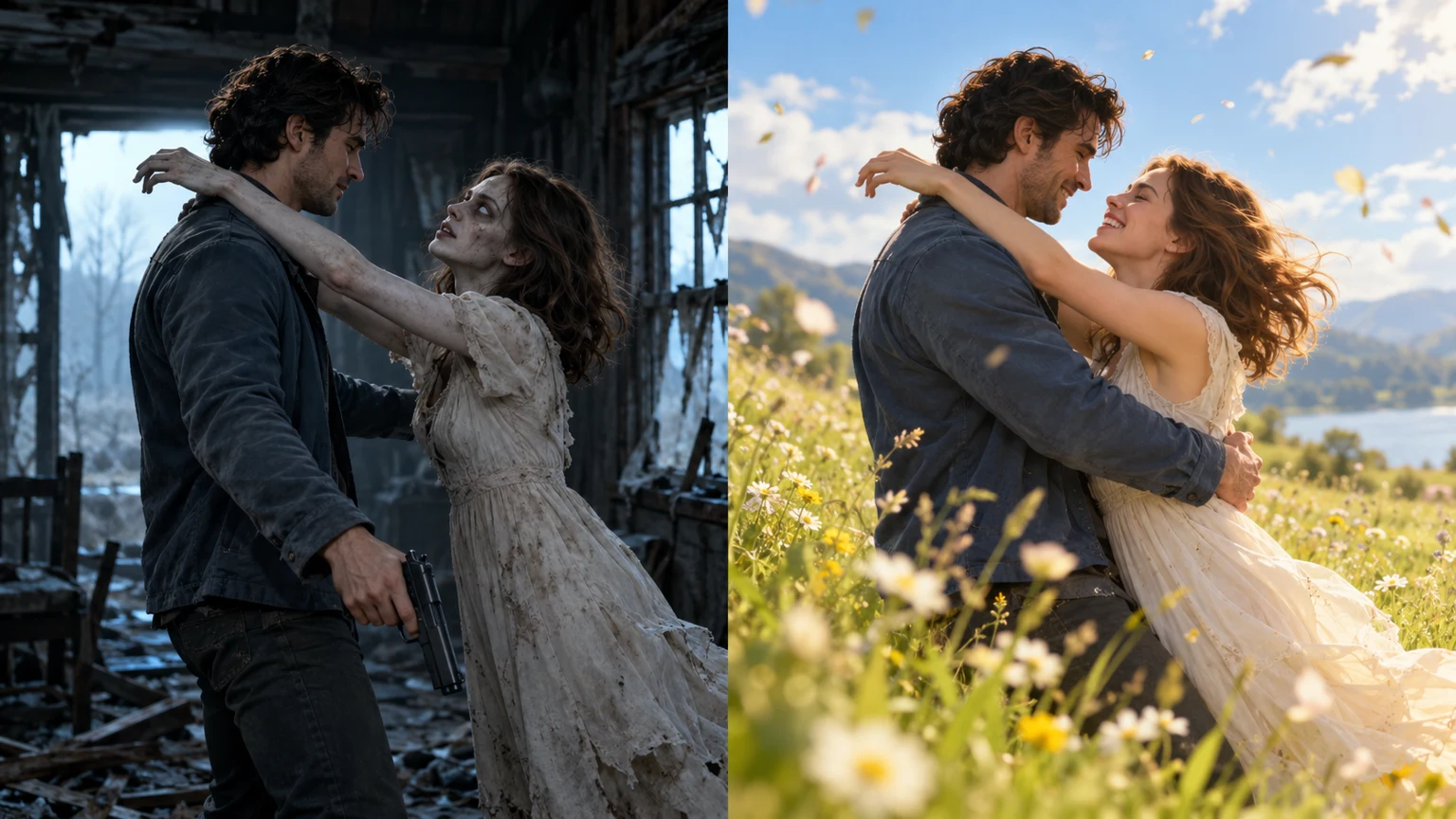
Instead of lunging violently, the infected partner hesitates. Their gaze softens with unmistakable sorrow and lingering recognition. Overcome by grief, the survivor slowly lowers the weapon. Tears well up in their eyes. Stepping forward, they wrap their arms around their infected partner in a desperate, sorrowful hug.
This moment—widely searched as the AI zombie hug—is the emotional pivot of the entire clip. It subverts the classic horror survival trope: love overcomes survival instinct.
Act III: The Match Cut Flashback (16s – 25s)
At the exact split-second the two characters embrace, the video executes a breathtaking match cut. While the physical coordinates, posture, and camera angle remain perfectly locked, the dreary cabin environment dissolves into a sunlit summer meadow before the outbreak.
Both characters are healthy, smiling, and dressed in clean summer clothes, holding each other under a radiant blue sky. The audio shifts from strained breathing and creaking floorboards to the gentle rustle of tall meadow grass and an ambient piano melody.
2. Why This Specific Narrative Resonates Globally
Why has the zombie ai trend outperformed conventional Halloween filters and scary video generators?
The Psychology of Bittersweet Contrast
Human psychology is profoundly affected by dramatic sensory contrast. Moving directly from cold, desaturated horror to warm golden-hour romance within 0.1 seconds creates a powerful emotional release. Comment sections across TikTok and Instagram are filled with users commenting: "Why am I crying over an AI zombie video at 2 AM?"
Algorithmic Watch Time & Replay Value
Social media recommendation algorithms heavily favor completion rate and re-watch percentage. Because the match cut transition in Act III happens so rapidly, viewers naturally loop the video two or three times to examine how the characters transformed and compare the pre- and post-outbreak details.
Relatable Humanity Over Horror
Mainstream social media audiences dislike graphic violence, and platform community guidelines frequently flag open wounds and blood splatters. By adhering to theatrical stage makeup and expressive emotional acting, the zombie ai video trend remains universally shareable across all ages and demographics.
3. How Creators Can Participate in the Zombie AI Trend
Whether you are a solo content creator, a couple celebrating Halloween, or a filmmaker experimenting with generative AI, there are multiple avenues to take part:
Method 1: Automated Turnkey Generator ($6.99)
If you prefer not to write complex multi-shot text prompts, manage cloud GPU hardware, or adjust technical motion sampling sliders, you can use our AI Zombie Video Generator or our specialized Zombie Love Story Generator.
Simply upload two photos—one of yourself and one of your partner, friend, or pet—and the platform handles the 3-act generation, character consistency, and 720P HD export automatically.
Method 2: Transforming Still Photos with an AI Zombie Filter
If you only need still images for social media profile pictures, Halloween phone wallpapers, or Discord avatars, try our AI Zombie Filter & Photo Editor. It applies realistic undead textures and cold color grading in 5 seconds while preserving your underlying facial geometry.
Method 3: Direct Prompting via Wan 2.1 or Kling AI
For experienced creators who want total control over seeds, camera paths, and custom NLE timelines, visit our Zombie AI Video Prompts Library to copy tested multi-scene text templates for tools like Wan 2.1, Kling AI 1.5, and Runway Gen-3 Alpha. You can also read our step-by-step How to Make AI Zombie Video Tutorial for practical framing tips.
4. Frequently Asked Questions
What is the zombie AI trend?
The zombie AI trend is a viral short-form video phenomenon where creators turn two portrait photos into an emotional 25-second story featuring a human survivor embracing their infected partner with a match cut to pre-outbreak memories.
Can I participate using photos of pets?
Yes! Many of the most popular viral clips feature an apocalyptic survivor reuniting with their beloved dog or cat, producing a heartwarming tribute that resonates widely with animal lovers.
Which tools are used to create these videos?
The trend is primarily powered by next-generation video foundation models including Wan 2.1, Kling AI, Hailuo MiniMax, and dedicated consumer platforms like ZombieTrend.
5. Summary & What Lies Ahead
The zombie ai trend demonstrates how generative video technology has matured from technical novelty to sophisticated narrative storytelling. By prioritizing character emotion, artistic restraint, and seamless cinematography, creators are discovering that AI tools can produce genuine cinematic art.
Ready to craft your own apocalyptic love story? Upload your reference photos on ZombieTrend today and bring your cinematic story to life.